
What Is the O Shot?
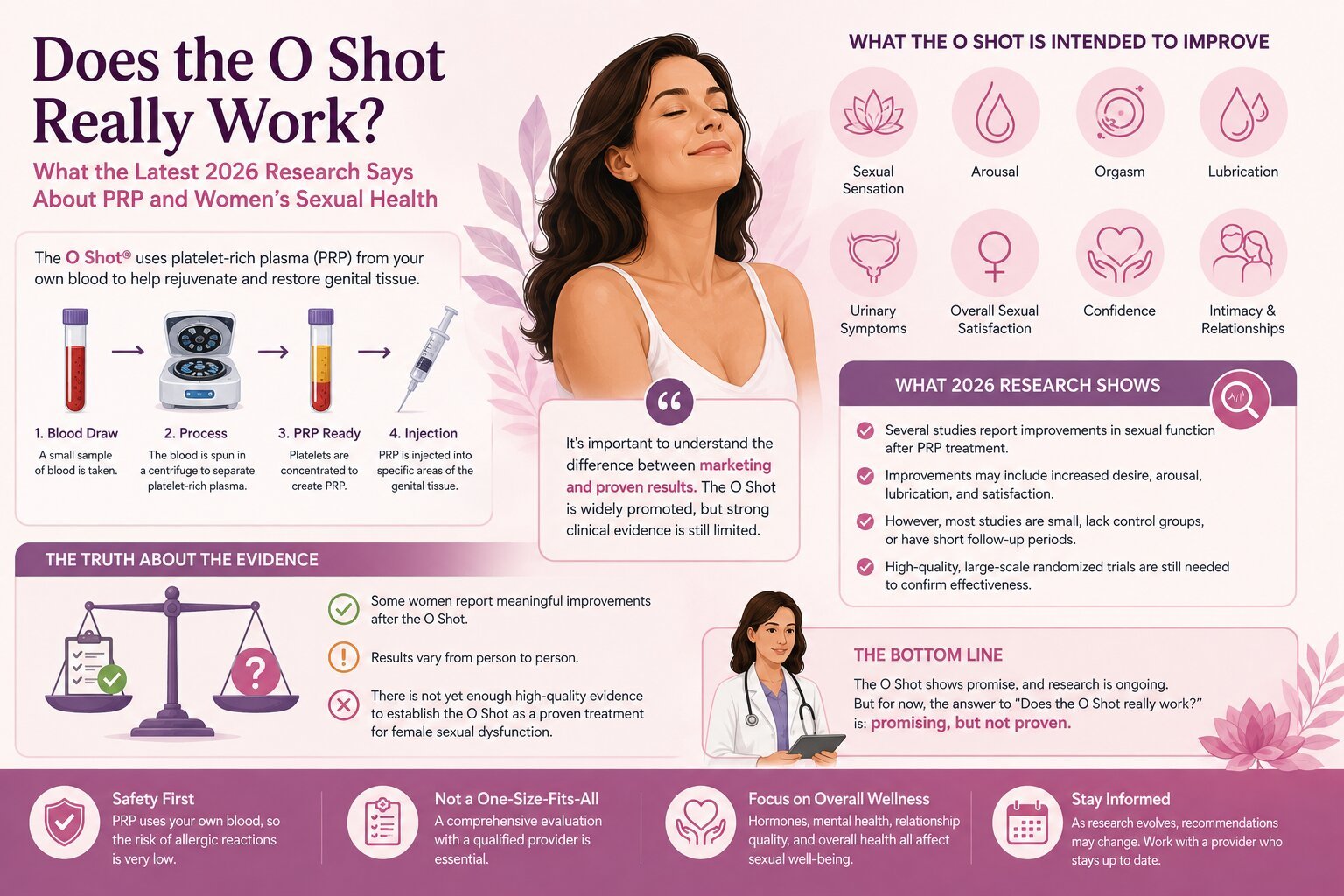
The O Shot is a procedure that uses platelet-rich plasma, commonly called PRP, with the aim of improving aspects of female sexual health. During the procedure, a clinician takes a small sample of the patient’s blood, processes it to concentrate platelets, and injects the resulting preparation into areas of the genital tissue. The treatment is promoted as a way to improve sexual sensation, arousal, orgasm, lubrication, and sometimes urinary symptoms.
That sounds appealing, especially if someone has been dealing with sexual problems that affect confidence or relationships. But there is an important distinction between a treatment being marketed for a particular purpose and a treatment being proven to work for that purpose. The O Shot falls into an area where clinical interest has moved faster than strong evidence.
The procedure is associated with the term O Shot because the treatment has been marketed specifically around the possibility of improving orgasm and sexual response. It is not the same thing as a standard, universally accepted treatment for female sexual dysfunction. Research into PRP for women’s sexual health remains active, but the studies available so far have important limitations.
That means the most honest answer to the question, “Does the O Shot really work?” is not a simple yes or no. Some studies have reported improvements in sexual function after PRP treatment, but researchers still do not have enough high-quality evidence to establish the O Shot as a proven treatment for female sexual dysfunction.
How PRP Is Used in the O Shot
PRP comes from the patient’s own blood. Platelets contain signaling substances involved in normal tissue repair, which has led researchers to investigate PRP in several areas of medicine. The theory behind genital PRP treatment is that these biological signals might influence tissue healing, blood flow, nerve-related responses, or other processes involved in sexual function.
The important word here is theory.
A biological mechanism can make a treatment interesting without proving that the treatment produces a meaningful benefit in real patients. This distinction matters in sexual medicine because sexual function depends on far more than local tissue biology. Hormones, medications, menopause, pelvic floor function, pain, relationship factors, mental health, sleep, cardiovascular health, and neurological conditions can all influence sexual wellbeing.
The O Shot therefore should not be viewed as a universal fix for every sexual health concern. A person experiencing painful sex because of severe vaginal dryness, for example, may have a very different underlying problem from someone who has difficulty reaching orgasm despite normal lubrication and no pain.
What the O Shot Claims to Improve
Providers who offer the O Shot may promote it for several concerns, including reduced sexual sensation, difficulty reaching orgasm, vaginal dryness, sexual discomfort, and urinary symptoms. Some promotional material also describes potential improvements in arousal and sexual satisfaction.
However, marketing claims are not the same as clinical evidence.
The available research has examined different patient groups, treatment techniques, injection sites, follow-up periods, and outcome measures. That makes the results difficult to compare directly. It also means that a positive finding from one small study should not automatically be interpreted as proof that the procedure will work for everyone.
For anyone considering treatment, the more useful question is not simply whether somebody reported an improvement after an O Shot. The better question is whether well-designed clinical trials show that PRP produces a reliable benefit beyond placebo effects, natural changes over time, or other treatments.
Does the O Shot Really Work?
What Clinical Research Actually Shows
Research into PRP for female sexual health has produced some encouraging findings, but the evidence remains preliminary. Several clinical studies have reported improvements in measures of sexual function after PRP treatment. Researchers have also investigated PRP for conditions involving vaginal tissue and sexual symptoms.
The problem is that many studies have been relatively small or lacked the controls needed to confidently determine whether PRP itself caused the improvement. Some studies use before-and-after measurements rather than comparing treatment with a placebo or sham procedure. That matters because sexual health outcomes can change for many reasons.
There is also a powerful psychological component. When someone expects a treatment to improve sexual function, that expectation can influence how they perceive symptoms and sexual experiences. This does not mean improvements are imaginary. It means researchers need rigorous study designs to separate the effect of the treatment from expectation and other influences.
Systematic reviews of PRP for female sexual dysfunction have generally reached a cautious position. The research suggests possible benefits, but the evidence is not yet strong enough to establish PRP as a reliably effective treatment.
Why the Evidence Is Still Limited
One major issue is study quality. A treatment can appear promising in early research and still fail to demonstrate a meaningful benefit when tested in larger, well-controlled trials.
Researchers also face another challenge with PRP: the treatment itself is not completely standardized. Different studies can use different methods to prepare PRP, different platelet concentrations, different injection techniques, and different treatment schedules. If the intervention varies substantially between studies, combining their findings becomes difficult.
Outcome measurement presents another challenge. Female sexual function is multidimensional. Desire, arousal, lubrication, orgasm, satisfaction, and pain are separate experiences, even though they can influence one another. A treatment that improves one measure does not necessarily improve overall sexual wellbeing.
This is why responsible medical reporting should avoid saying that PRP definitely works or that it definitely does not work. The current evidence supports continued research, not exaggerated certainty.
What Does the Latest Research Say About PRP?
Findings From Reviews and Clinical Studies
Recent reviews of PRP in female sexual medicine continue to describe the treatment as promising but insufficiently established. Researchers have reported potential improvements in validated female sexual function scores in some studies. Yet reviews also highlight limitations involving sample size, study design, lack of control groups, inconsistent protocols, and relatively short follow-up.
That pattern is important for patients reading online claims about the O Shot. If you find a clinic saying that research proves PRP works, look at what the research actually tested. A study involving a small group of participants who received PRP and reported improvement afterward provides useful information, but it does not provide the same level of evidence as a large randomized controlled trial.
The FDA also has not approved the O Shot as a treatment for female sexual dysfunction. That does not mean the procedure has been proven harmful. It means consumers should be careful when promotional language makes a procedure sound more established than the scientific evidence supports.
The US Food and Drug Administration has repeatedly warned consumers about regenerative medicine products and procedures that are promoted beyond established evidence. PRP is widely studied and used in medicine, but evidence for one application cannot automatically be transferred to another. Evidence that PRP may help a tendon injury, for example, does not prove that injecting PRP into genital tissue improves sexual function.
The Importance of Study Quality
Think of medical evidence like a ladder. Anecdotal reports sit near the bottom. They can raise an interesting question, but they cannot answer it reliably. Small observational studies move us higher, while randomized controlled trials and well-conducted systematic reviews provide stronger evidence.
The O Shot currently has more questions than definitive answers at the highest levels of that ladder.
That distinction is particularly important because female sexual dysfunction has many possible causes. If a person has low desire related to an antidepressant, treating the genital tissue may not solve the underlying problem. If pain during intercourse results from pelvic floor dysfunction, an injection may not address the muscular cause. If vaginal symptoms result from menopause-related genitourinary changes, established treatments may deserve discussion before an experimental or less established procedure.
Good sexual healthcare starts with identifying the cause rather than simply choosing the most heavily marketed procedure.
Can the O Shot Improve Female Sexual Function?
Sexual Desire, Arousal and Orgasm
Some studies have reported improvements in sexual function after PRP treatment, including measures related to arousal and orgasm. These findings are interesting, but they should not be interpreted as proof that the O Shot reliably produces better orgasms.
Sexual response involves the brain, nervous system, hormones, blood flow, genital sensation, emotional wellbeing, and personal circumstances. Improving one biological factor may help some people while making little difference for others.
That is why a proper assessment matters. A clinician should ask about symptoms, medications, menopause status, pain, relationship factors, mental health, and other relevant medical conditions before recommending treatment.
Vaginal Dryness and Pain
Vaginal dryness and painful intercourse are also areas where patients may encounter PRP claims. However, these symptoms can have well-established causes, particularly around menopause. Changes in estrogen can affect vaginal tissue and produce dryness, burning, irritation, and discomfort during sex.
Evidence-based treatments already exist for several causes of these symptoms. Depending on the diagnosis, options can include lubricants, moisturizers, pelvic floor therapy, hormonal treatments, or other medical approaches.
That does not mean PRP research should be dismissed. It means patients should not skip established diagnostic and treatment pathways simply because a newer procedure sounds more advanced.
Is the O Shot Safe?
Potential Side Effects and Risks
Because the O Shot involves injections into sensitive genital tissue, it is not risk-free. Possible problems can include pain, bleeding, bruising, swelling, infection, temporary changes in sensation, and discomfort at the injection site.
There is another issue that deserves attention: uncertainty about long-term outcomes. When a treatment has limited high-quality research, researchers may have less information about uncommon complications and long-term effects.
Patients should also consider who performs the procedure, what medical training they have, how the PRP is prepared, what infection control procedures are used, and what happens if complications occur.
A reputable provider should be comfortable discussing uncertainty rather than presenting the O Shot as a guaranteed solution.
What Do Medical Organizations Say?
Why Professional Guidance Matters
Professional medical guidance is useful because it separates established treatment from emerging or insufficiently proven approaches. Organizations such as the American College of Obstetricians and Gynecologists have emphasized the lack of high-quality evidence for several procedures marketed to improve female sexual function or genital health.
The broader message is consistent: patients deserve accurate information about benefits, risks, alternatives, and the quality of evidence before undergoing elective procedures.
That approach is especially important for sexual health. People often search for solutions privately and may encounter highly persuasive testimonials before they ever speak with a qualified healthcare professional.
A testimonial can tell you what happened to one person. A well-designed clinical trial tells you much more about what is likely to happen across a population.
Who Might Consider the O Shot?
The O Shot may be something a patient discusses with a qualified clinician when more established explanations and treatments have been considered and the person understands that the evidence for PRP in female sexual health remains uncertain. It should not be presented as a first-line treatment for every concern involving orgasm, desire, lubrication, or sexual discomfort. A proper evaluation matters because sexual symptoms can result from medications, hormonal changes, pelvic floor disorders, pain conditions, psychological factors, chronic disease, neurological problems, or relationship concerns. Treating the wrong cause can mean spending money and undergoing an invasive procedure without addressing what is actually affecting sexual wellbeing.
This is particularly relevant for people experiencing symptoms after menopause. Genitourinary symptoms associated with menopause have established diagnostic and treatment approaches, and a healthcare professional can explain which options fit the individual situation. The same principle applies to someone taking medication that affects sexual function. Certain antidepressants and other medicines can influence libido or orgasm, so reviewing medications may be more useful than immediately pursuing an injection.
There is also a practical financial question. The O Shot is generally offered as a private procedure rather than a universally established medical treatment covered as standard care. Patients should ask about the total cost, the number of treatments recommended, follow-up appointments, and what happens if the treatment does not produce the expected result. A treatment can sound simple when described as “using your own blood,” but that does not make it automatically effective or risk-free.
What Should You Ask Before Treatment?
Before paying for an O Shot, ask the clinician to explain the evidence in plain language. A trustworthy provider should be able to discuss what studies show, where the evidence is uncertain, and what alternatives exist. Be cautious if someone promises a guaranteed orgasm, permanent improvement, or a specific success rate without pointing you toward credible clinical evidence.
It is also reasonable to ask whether the provider has diagnosed the cause of your symptoms. If the problem is pain, dryness, low desire, or difficulty reaching orgasm, those symptoms deserve different questions. For example, someone with painful intercourse may need evaluation for vaginal tissue changes, infection, pelvic floor problems, vulvar conditions, or other causes. Someone with low desire may need a completely different assessment involving hormones, medications, mental health, sleep, stress, and relationship factors.
A few practical questions can make the consultation much more useful:
- What diagnosis are you treating?
- What evidence supports PRP for this specific problem?
- Was the research randomized and controlled?
- What benefits should I realistically expect?
- What are the known risks and uncertainties?
- What established treatments should I consider first?
- What happens if the treatment does not help?
Those questions are not meant to make the conversation uncomfortable. They are there to make it more useful. Good healthcare should survive careful questions.
O Shot Alternatives With Better Established Evidence
The best treatment depends on the reason sexual function has changed. There is no single therapy that works for every woman, which is precisely why diagnosis comes before treatment.
For vaginal dryness and discomfort related to menopause, clinicians may discuss vaginal moisturizers, lubricants, and hormonal treatments when appropriate. Local vaginal estrogen has an established role for appropriate patients with genitourinary symptoms of menopause. Other prescription options may also be considered depending on symptoms and medical history.
Pelvic floor physical therapy can be useful when pelvic floor muscle dysfunction contributes to pain or sexual difficulties. A qualified pelvic health physical therapist can assess muscle tension, coordination, strength, and other factors that may contribute to symptoms.
For low sexual desire, treatment depends heavily on the underlying cause. Some women may benefit from addressing medication effects, relationship concerns, depression, anxiety, sleep problems, or other health conditions. Specific prescription treatments may also be appropriate for some premenopausal women with diagnosed hypoactive sexual desire disorder, although these medications have their own indications, limitations, and risks.
The important point is that established treatments should not be overlooked simply because PRP sounds newer or more technologically advanced. New does not automatically mean better. Sometimes the boring answer is actually the useful one.
Final Verdict: Does the O Shot Really Work?
So, does the O Shot really work?
The most evidence-based answer in 2026 is we do not yet know with enough certainty to call it a proven treatment for female sexual dysfunction.
Research into PRP is interesting. Some clinical studies have reported improvements in sexual function and related symptoms, and researchers continue to investigate how PRP might affect genital tissue. However, the overall evidence remains limited by small studies, differences in PRP preparation and treatment methods, inconsistent outcome measures, and a shortage of large, high-quality randomized controlled trials.
That does not prove the O Shot never helps anyone. It means the current evidence cannot reliably tell us who will benefit, how much improvement to expect, how long benefits might last, or which PRP protocol works best.
For patients, that distinction matters. An evidence-based decision is not necessarily a decision against treatment. It is a decision made with an accurate understanding of uncertainty.
If you are considering the O Shot, discuss your symptoms with a qualified healthcare professional who can investigate the underlying cause and explain established treatment options alongside the evidence for PRP. Be particularly cautious about guaranteed results, dramatic before and after claims, and statistics that cannot be traced to high-quality published research.
The O Shot remains an area of scientific interest, but promising research is not the same as proven treatment. Until stronger trials provide clearer answers, patients should approach PRP for sexual health as an emerging option rather than an established solution.