
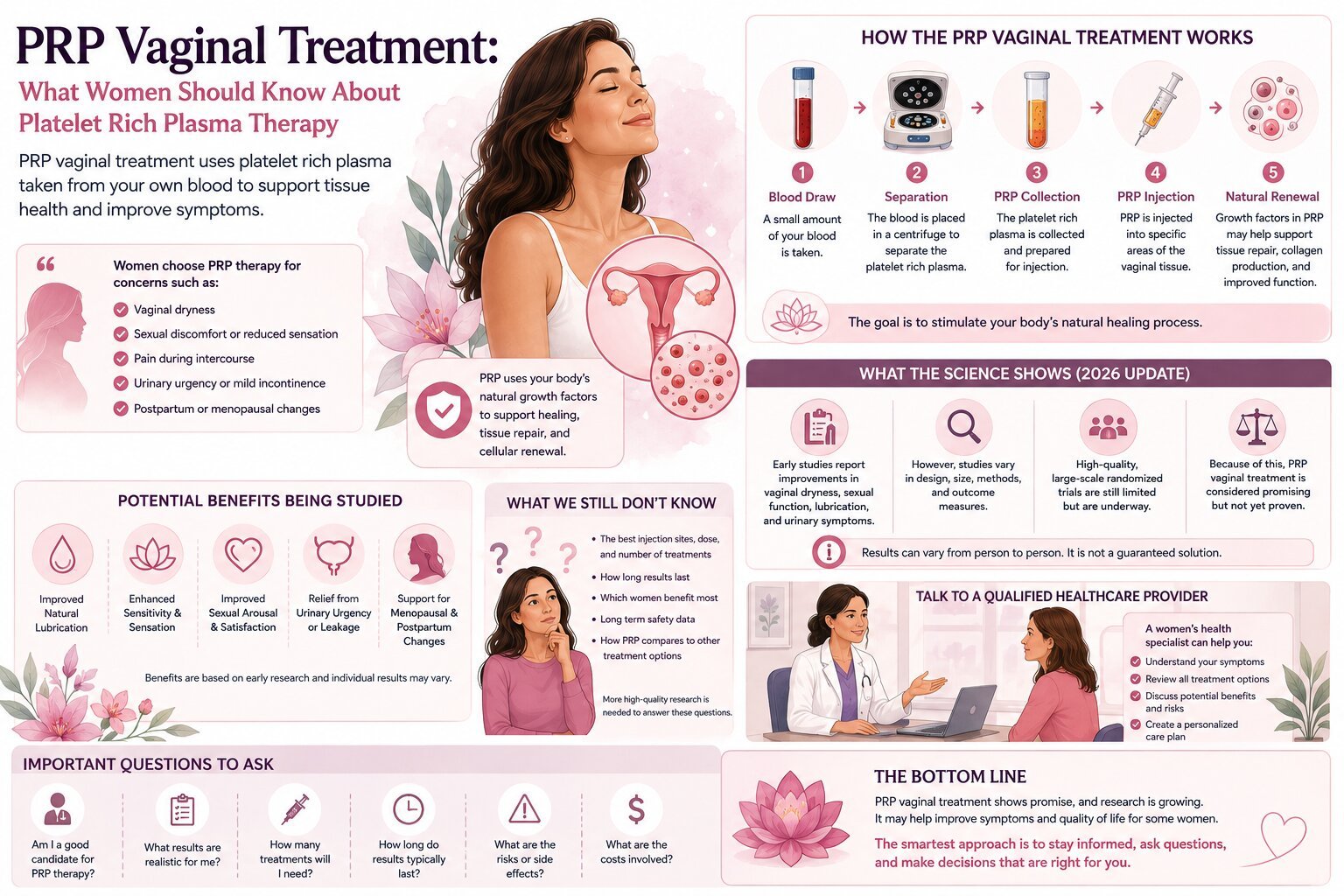
Women are increasingly hearing about PRP vaginal treatment, a procedure that uses platelet rich plasma taken from their own blood. Clinics may promote it for concerns such as vaginal dryness, sexual discomfort, reduced sensation, or urinary symptoms. That sounds promising, but it also creates an important question: what does the science actually show?
The answer is more nuanced than many advertisements suggest. PRP has attracted considerable interest because platelets contain growth factors and other substances involved in tissue repair. Researchers are investigating whether those properties can support healing or improve certain symptoms in gynecology.
At the same time, vaginal PRP remains an area of developing research. Some early studies have reported improvements in particular symptoms, but studies vary considerably in design, size, treatment methods, and outcome measures. That makes it difficult to promise a predictable result.
For women considering treatment, the smartest approach is not to treat PRP as a miracle procedure or dismiss it outright. Instead, it helps to understand what happens during treatment, what evidence exists, what remains uncertain, and what questions to ask a qualified healthcare professional.
What Is PRP Vaginal Treatment?
PRP vaginal treatment involves using platelet rich plasma prepared from a woman's own blood. A clinician usually takes a small blood sample and processes it to concentrate platelets within the plasma. The resulting preparation is then used in the targeted treatment area.
Platelets are best known for their role in blood clotting. They also contain biological substances involved in tissue repair. This is one reason clinicians and researchers have explored PRP in several areas of medicine, including orthopedics, dermatology, sports medicine, and regenerative medicine.
In gynecology, researchers have investigated whether PRP could influence vaginal or vulvovaginal tissue and potentially improve certain symptoms. The proposed mechanism is biologically plausible, but a plausible mechanism is not the same thing as proven clinical effectiveness.
That distinction matters. A treatment can have an interesting biological rationale while still requiring stronger clinical trials before doctors can confidently recommend it as a standard therapy.
How Platelet Rich Plasma Is Prepared
The process generally starts with drawing blood from the patient. The sample is placed into a centrifuge or another processing system designed to separate its components. The clinician then collects the plasma containing a higher concentration of platelets.
The exact preparation method can differ between clinics and studies. There is no single universal PRP formulation used for every vaginal application. Platelet concentration, processing techniques, injection protocols, and the number of sessions may all vary.
This variation makes online treatment comparisons difficult. Two clinics may both advertise PRP while using noticeably different protocols.
Why Are Women Considering Vaginal PRP?
Women may seek information about PRP because of symptoms affecting comfort, intimacy, or quality of life. These symptoms can have many causes, including hormonal changes, menopause, childbirth, pelvic floor problems, infections, medications, dermatological conditions, and other medical issues.
PRP should therefore not be viewed as a one size fits all solution.
A proper medical assessment can help identify what is actually causing the problem before someone considers an injection based treatment.
Sexual Health and Vaginal Symptoms
Some PRP studies have investigated symptoms involving sexual function, vaginal discomfort, lubrication, and tissue changes. Researchers have also explored whether PRP might influence sexual satisfaction or pain associated with intercourse.
However, sexual health is complicated. Hormones, medications, relationship factors, pelvic floor muscle activity, mental health, nerve function, and underlying medical conditions can all contribute to symptoms.
That means an improvement after treatment does not automatically prove that PRP caused the change. It also explains why researchers need well designed controlled studies rather than relying only on patient reports.
Urinary and Pelvic Floor Concerns
Some clinics promote PRP for urinary symptoms or pelvic floor related concerns. Research into these applications exists, but evidence remains developing.
Urinary leakage, urgency, pelvic pressure, and pelvic pain can have different causes. Treatment may require pelvic floor physiotherapy, medication, behavioral changes, hormonal therapy, or other medical interventions depending on the diagnosis.
A woman experiencing new urinary or pelvic symptoms should therefore receive an appropriate evaluation rather than assuming that PRP is the underlying answer.
What Does the Research Say About Vaginal PRP?
The scientific interest in vaginal PRP is real, but the evidence should be interpreted carefully.
Reviews and clinical studies have reported potentially positive findings for some gynecological and sexual health outcomes. However, researchers have also highlighted major limitations, including small sample sizes, inconsistent protocols, limited follow up, and a lack of large high quality randomized controlled trials.
That means there is not enough evidence to describe vaginal PRP as a proven treatment for every condition commonly mentioned in marketing material.
What Studies Have Found
Published research has explored PRP for issues including female sexual dysfunction, vulvovaginal symptoms, and aspects of genitourinary health. Some studies have reported improvements in symptom scores following treatment.
Those findings are useful because they help researchers identify areas that deserve further investigation. They do not automatically establish that PRP works better than established treatments or placebo treatment.
Medical evidence becomes stronger when independent research produces similar results across larger groups of patients. That is particularly important for procedures marketed as regenerative therapies.
Where the Evidence Is Still Limited
One of the biggest challenges is inconsistency. Researchers do not always use the same PRP preparation, injection technique, treatment schedule, or measurement tools.
Long term safety and effectiveness also deserve attention. A short study showing improvement several weeks after treatment cannot answer every question about results years later.
For patients, the practical message is simple: vaginal PRP is promising enough to study, but it should not be presented as a guaranteed or universally established treatment.
What Happens During a PRP Vaginal Treatment?
A typical appointment begins with a medical consultation. The clinician should discuss symptoms, medical history, medications, previous treatments, and the reason the patient is considering PRP.
Blood is then collected and processed to prepare the platelet rich plasma. The clinician applies or injects the preparation according to the treatment protocol.
The exact procedure varies between providers and the area being treated. Because protocols are not standardized, women should ask exactly what procedure the clinic performs rather than relying on the general label "vaginal PRP."
A reputable provider should also explain alternatives, expected benefits, possible risks, and the uncertainty surrounding the evidence.
Is Vaginal PRP Painful?
Discomfort depends on the treatment technique, injection location, individual sensitivity, and whether local anesthetic is used.
Some women may experience temporary stinging, pressure, tenderness, or discomfort around the treatment area. A clinician should explain what sensations to expect before starting.
Severe or persistent pain should not simply be accepted as part of the process. If significant symptoms develop after treatment, the patient should contact the treating healthcare professional for advice.
Recovery After PRP Vaginal Treatment
Recovery is generally described as relatively short, but aftercare depends on the specific procedure performed.
Patients may experience temporary tenderness, swelling, spotting, or irritation. The treating clinician should provide personalized instructions about sexual activity, exercise, bathing, medications, and other activities.
Women should follow those instructions rather than assuming every PRP procedure has the same recovery period.
It is also important to remember that feeling different shortly after treatment does not necessarily mean the treatment has worked. Any proposed biological effect may take time, and some symptoms may not improve at all.
Potential Benefits and Limitations
The main attraction of PRP is its use of material derived from the patient's own blood. Researchers are interested in the growth factors and signaling substances associated with platelets and their possible role in tissue repair.
Some clinical studies have reported improvements in selected symptoms. That gives PRP a legitimate place in ongoing research.
The limitations are equally important. Evidence quality varies, treatment protocols are not standardized, and long term data remain limited for many proposed vaginal applications.
Patients should be especially cautious when a clinic promises dramatic or permanent results. Good healthcare rarely needs a magic wand.
Side Effects and Safety Considerations
Because PRP is prepared from the patient's own blood, concerns about allergic reactions to donor material are different from treatments involving another person's biological material. That does not make the procedure risk free.
Injection based procedures can cause pain, bleeding, bruising, swelling, infection, or irritation. The level of risk depends on the technique and treatment site.
A provider should use appropriate infection control procedures and explain potential complications before treatment.
Women should also tell their clinician about medications, bleeding disorders, infections, pregnancy, immune conditions, and other relevant health issues before undergoing treatment.
Who May Not Be a Good Candidate?
PRP may not be appropriate for everyone. Suitability depends on the patient's symptoms, diagnosis, general health, medications, and the specific protocol being considered.
For example, unexplained vaginal bleeding, active infection, or an undiagnosed pelvic health problem requires medical evaluation rather than simply moving forward with an elective procedure.
The best candidate is not necessarily someone looking for the latest treatment. It is someone whose symptoms have been properly evaluated and who understands both the potential benefits and the uncertainties.
How to Choose a Qualified Provider
Provider quality matters enormously with any procedure involving injections.
Look for an appropriately licensed healthcare professional with relevant training in women's health, gynecology, sexual medicine, or another field appropriate to the problem being treated.
Ask who will perform the procedure, where it will take place, what preparation system is used, and how complications are handled.
A trustworthy clinic should be comfortable discussing uncertainty. Be cautious if someone claims that PRP can reliably reverse aging, permanently restore vaginal tissue, cure every sexual problem, or guarantee a particular result.
PRP Vaginal Treatment vs Other Vaginal Therapies
PRP is only one option among many. The right treatment depends on the underlying condition.
For example, vaginal symptoms associated with menopause may have established treatment options, including nonhormonal approaches and, for appropriate patients, certain hormonal therapies. Pelvic floor dysfunction may respond to specialized physiotherapy. Infections require diagnosis and appropriate antimicrobial treatment.
This is why comparing treatments based only on advertising can be misleading.
The useful question is not simply, "Which treatment sounds newest?" It is, "Which treatment has the best evidence and risk profile for my specific diagnosis?"
Questions to Ask Before Treatment
Before booking vaginal PRP, consider asking:
- What diagnosis are you treating?
- What evidence supports PRP for this specific condition?
- What alternative treatments are available?
- How many treatments do you recommend?
- What side effects should I expect?
- What happens if my symptoms do not improve?
- Who will perform the procedure?
- How is the PRP prepared?
- What follow up will I receive?
- What evidence supports the clinic's specific protocol?
Clear answers can tell you a lot about a provider.
Cost and Treatment Expectations
The price of PRP vaginal treatment varies between clinics and locations. There is no single universal price that applies to every patient.
More importantly, cost should not be the only factor when evaluating treatment. Women should find out whether consultation, preparation, treatment, follow up, and any additional sessions are included.
Patients should also ask whether the treatment is being offered as an established medical therapy or as an emerging option with limited evidence.
A lower price is not automatically a better deal, and a higher price does not automatically mean better medicine.
What Women Should Know Before Booking
PRP vaginal treatment is an interesting area of regenerative medicine, but the evidence deserves a careful reading.
Some early research suggests potential benefits for selected vaginal and sexual health symptoms. However, the available evidence does not justify treating PRP as a guaranteed cure or a universal replacement for established medical care.
Women considering the procedure should first identify the cause of their symptoms. They should then discuss evidence based options with a qualified healthcare professional.
Most importantly, do not let marketing pressure replace medical judgment. If a clinic promises that one injection will solve a complicated health problem forever, that is a good moment to slow down and ask more questions.
Frequently Asked Questions
Conclusion
PRP vaginal treatment has attracted attention because it uses platelet rich plasma from a patient's own blood and may have regenerative effects. Early research offers some encouraging findings, particularly in selected areas of women's sexual and vulvovaginal health.
Still, promising research is not the same as definitive proof. Differences between studies, small participant numbers, inconsistent treatment protocols, and limited long term evidence mean women should approach PRP with realistic expectations.
For anyone considering treatment, the strongest starting point is a proper diagnosis and an honest conversation with a qualified healthcare professional. Ask about evidence, alternatives, risks, expected results, and what happens if the treatment does not work.
That approach puts health before hype, which is exactly where it belongs.
Sources and Further Reading
- ACOG: Committee Opinion on elective female genital cosmetic surgery and related concerns.
- U.S. Food and Drug Administration: Information and safety communications concerning products and procedures marketed for vaginal rejuvenation and related uses.
- PubMed, National Library of Medicine: Peer reviewed research on platelet rich plasma and female sexual or vulvovaginal health.
- The North American Menopause Society: Evidence based information concerning genitourinary symptoms associated with menopause.
- International Society for the Study of Women's Sexual Health: Professional resources concerning female sexual health and sexual medicine.