
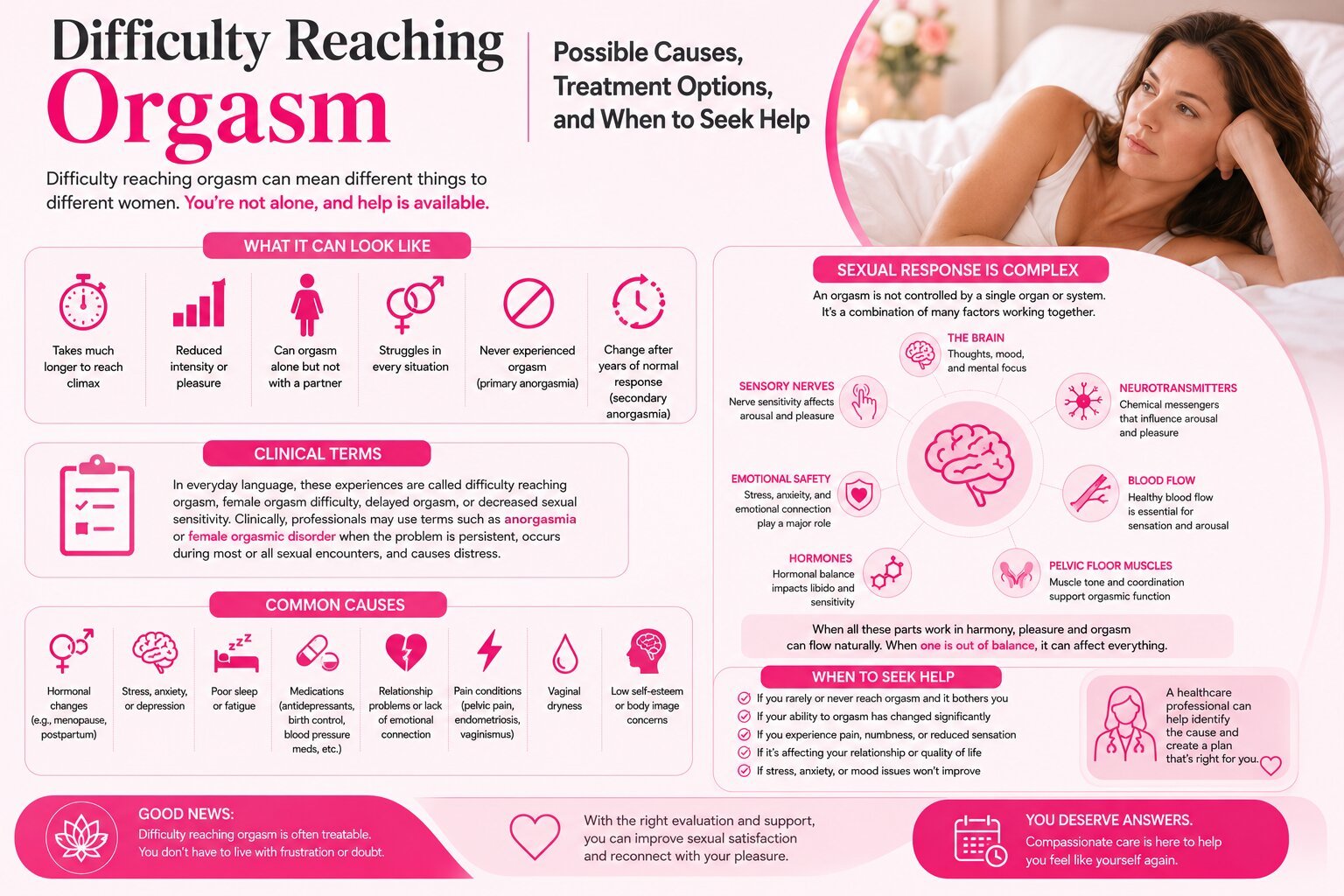
Experiencing changes in sexual response can feel confusing and isolating. Whether an orgasm takes much longer than it used to, feels muted, or seems impossible to reach, understanding the complex interplay between hormones, nerves, blood flow, medications, and emotional wellbeing is the first step toward reclaiming your intimate vitality.
What Does Difficulty Reaching Orgasm Mean?
Difficulty reaching orgasm can mean different things to different women, and that distinction is essential before assuming that something is permanently broken or medically wrong. One woman may notice that climax takes substantially longer than it used to, while another may experience a clear reduction in orgasmic intensity or need significantly more intense stimulation to reach the same level of pleasure.
Some women can orgasm during solo masturbation but struggle during partnered sexual activity, while others find that orgasm has become elusive in every situation. There are also women who have never experienced orgasm (primary anorgasmia), which represents a distinct clinical pattern from a sudden or gradual change in sexual function after years of predictable response (acquired or secondary anorgasmia).
In everyday language, people describe these experiences as difficulty reaching orgasm, female orgasm difficulty, delayed orgasm, or decreased sexual sensitivity. Clinically, healthcare professionals use terms such as anorgasmia or female orgasmic disorder when symptoms persist, occur during most or all sexual encounters, and cause meaningful personal or relational distress.
An orgasm is not controlled by a single organ or solitary body system. Sexual response involves the brain, neurotransmitters, sensory nerves, microvascular blood vessels, pelvic floor musculature, hormones, emotional safety, attention, and the exact type of physical stimulation a person receives. Think of it like an orchestra: when all sections work in harmony, the music flows naturally; but a disruption in even one section—such as reduced blood flow, nerve attenuation, or hormonal decline—can alter the entire performance.
Medical authorities, including the Merck Manual, define female orgasmic disorder as involving absent, infrequent, markedly delayed, or substantially reduced orgasms despite adequate sexual stimulation and arousal.
Key Takeaway on Normal Variation
There is no universal “normal” orgasm timeline. Some women climax quickly, some need extended stimulation, and many do not orgasm during every sexual encounter. An occasional difficulty is normal. The concern becomes significant when it is persistent, creates distress, or represents a noticeable change from your previous baseline.
Is Female Orgasm Difficulty Common?
Female orgasm difficulty is far more common than most women realize, primarily because intimate concerns are kept private and rarely discussed openly. Many women privately worry that everyone else reaches climax effortlessly and that struggling to do so indicates an anatomical failure.
In clinical reality, female sexual response varies widely and naturally evolves across different life stages. The American College of Obstetricians and Gynecologists (ACOG) reports that approximately 4 in 10 women experience a sexual problem at some point in their lives, involving desire, arousal, orgasm, pain, or medication side effects. Sexual health concerns are ordinary medical issues that deserve respectful, evidence-based attention.
A major source of confusion stems from unrealistic cultural scripts. Many women grow up believing that vaginal penetration alone should reliably induce climax, yet anatomical research demonstrates that the vast majority of women require direct or indirect clitoral stimulation to achieve orgasm. Clitoral anatomy, nerve density, and blood supply differ from person to person, and what worked five years ago may shift due to age, hormones, medications, stress, or childbirth.
The clinical benchmark is distinguishing between natural variation and personal distress. If a woman rarely orgasms but feels fulfilled and content, treatment is unnecessary. However, if a woman who previously climaxed easily experiences sudden difficulty, numbness, or frustration, a comprehensive evaluation can pinpoint the underlying physiological or hormonal triggers.
Common Causes of Difficulty Reaching Orgasm
Because sexual response involves multiple biological and psychological systems, there is rarely a single, isolated cause for orgasmic difficulty. Searching for a single “magic hormone” or assuming that every challenge is psychological can lead to frustration. Often, multiple subtle factors overlap.
Below are the most frequent contributing factors identified in clinical practice:
1. Hormonal Changes and Menopause
Hormones exert a profound influence on vulvar, vaginal, and clitoral tissues. Estrogen maintains mucosal thickness, elasticity, and natural lubrication, while testosterone and DHEA support clitoral engorgement, nerve responsiveness, and libido.
During perimenopause and menopause, declining estrogen levels frequently cause Genitourinary Syndrome of Menopause (GSM) and vaginal atrophy. Tissues become thinner, drier, and less elastic, which can make intercourse uncomfortable or painful. When physical stimulation causes burning or friction rather than pleasure, arousal naturally stalls, making orgasm difficult or impossible.
Hormonal shifts during pregnancy, the postpartum period, and breastfeeding can similarly lower estrogen and elevate prolactin, leading to temporary dryness, fatigue, and muted sexual response. Addressing these hormonal shifts through targeted hormone optimization and Bioidentical Hormone Replacement Therapy (BHRT) can restore healthy tissue perfusion and comfort.
2. Decreased Genital or Clitoral Sensitivity
Some women describe their difficulty not as a lack of desire, but as a direct loss of physical sensation. Stimulation that previously felt pleasurable may feel muted or numbed, requiring intense mechanical vibration or prolonged effort to register.
Genital sensitivity depends on intact sensory nerve pathways (such as the pudendal nerve) and healthy microcirculation. Sensitivity can diminish due to:
- Age-related vascular changes: Reduced arterial inflow to the clitoral corpus cavernosum.
- Childbirth trauma: Stretching or tearing of perineal and pelvic nerve branches during vaginal delivery.
- Pelvic surgery or radiation: Hysterectomy, prolapse repair, or oncologic treatments that affect pelvic innervation.
- Metabolic conditions: Diabetes mellitus or neuropathies that impair microvascular and neural function.
Regenerative treatments such as the O-Shot (PRP therapy) are specifically designed to address decreased sensitivity by introducing concentrated growth factors that stimulate neovascularization (new blood vessel formation) and nerve tissue regeneration in the clitoral and anterior vaginal wall.
3. Medications and Sexual Side Effects
Pharmacological side effects are one of the most common—yet frequently overlooked—causes of delayed or blocked orgasm. Selective Serotonin Reuptake Inhibitors (SSRIs) and SNRIs, commonly prescribed for depression and anxiety, significantly increase serotonin activity, which can suppress the spinal reflexes and dopamine pathways necessary for orgasm.
Other medications that may interfere with sexual function include:
| Medication Category | Common Examples | Impact on Sexual Response |
|---|---|---|
| Antidepressants (SSRIs/SNRIs) | Sertraline, Fluoxetine, Escitalopram, Duloxetine | Delayed climax, anorgasmia, reduced genital arousal |
| Antihypertensives | Beta-blockers, Diuretics, ACE inhibitors | Reduced peripheral blood flow to genital tissues |
| Oral Contraceptives | Combination birth control pills | Elevated SHBG, lowered free testosterone, vaginal dryness |
| Antihistamines & Anticholinergics | Diphenhydramine, allergy medications | Mucosal dryness and decreased natural lubrication |
Important Medical Caution: Never abruptly discontinue or adjust prescription psychiatric or cardiovascular medications on your own. Discuss symptoms with your prescribing clinician, who can safely adjust dosages, switch to medications with lower sexual side-effect profiles (e.g., Wellbutrin/bupropion), or suggest complementary strategies.
4. Stress, Anxiety, Depression, and Mental Health
The brain is the body’s primary sex organ. Chronic psychological stress elevates cortisol and sympathetic nervous system tone (“fight or flight”), which constricts peripheral blood vessels and actively inhibits the parasympathetic state needed for arousal and lubrication.
Performance anxiety creates a frustrating cognitive loop known as “spectatoring”: instead of immersing herself in physical sensations, a woman monitors her body, worries about taking too long, or stresses over disappointing a partner. This mental self-surveillance pulls attention away from pleasure, making climax virtually impossible.
5. Sexual Stimulation and Arousal Factors
Sometimes the barrier is neither hormonal nor neurological, but rather a mismatch between the stimulation provided and what an individual’s body requires. Because clitoral anatomy and nerve distribution vary, direct, indirect, rhythmic, or variable pressure may be necessary.
Rushing into intercourse without sufficient foreplay or arousal prevents the clitoral bulb and vestibular erectile tissues from becoming fully engorged. Taking time for self-exploration and communicating preferences openly can resolve many stimulation-related challenges.
6. Pelvic Floor Problems, Pain, and Medical Conditions
The pelvic floor muscles contract rhythmically during orgasm at 0.8-second intervals. When these muscles are hypertonic (overly tight), weak, or uncoordinated, orgasmic function is impaired.
Painful intercourse (dyspareunia), provoked vestibulodynia, endometriosis, pelvic floor spasms, and interstitial cystitis trigger involuntary muscle guarding. When the brain anticipates pain, it suppresses sexual excitement. Specialized pelvic floor physical therapy and medical management can help relax tight muscles and restore comfortable function.
7. Relationship, Communication, and Emotional Factors
Emotional safety, mutual trust, and transparent communication form the foundation of satisfying intimacy. Unresolved relationship friction, fear of judgment, past negative experiences, or lack of privacy create subconscious barriers to letting go during intimacy. Sex therapy or couples counseling can provide a neutral, supportive setting to realign expectations and enhance intimacy.
Why Would Orgasms Suddenly Become More Difficult?
When a woman has enjoyed a predictable, satisfying sex life for years and suddenly finds that climax has become delayed, weak, or impossible, the sudden onset provides crucial diagnostic clues.
Healthcare providers evaluate sudden changes by examining:
- Recent Medication Changes: Starting an antidepressant, oral contraceptive, or blood pressure drug within the past 1–6 months.
- Perimenopausal Hormone Shifts: Rapid drops in estradiol or bioavailable testosterone.
- Recent Procedures or Trauma: Gynecological surgeries, pelvic floor repairs, episiotomies, or spinal issues.
- New Neurological or Systemic Symptoms: Genital numbness, bowel/bladder changes, tingling, or unexplained fatigue.
Tracking when the change started and whether it occurs during both masturbation and partnered intimacy helps clinicians distinguish between organic physical causes and situational or contextual factors.
How Is Difficulty Reaching Orgasm Diagnosed and Evaluated?
There is no single blood test or diagnostic scan that explains every case of orgasmic difficulty. A thorough evaluation by a sexual wellness physician, gynecologist, or integrative doctor begins with a comprehensive, compassionate clinical history.
Your clinician may evaluate:
- Sexual Response History: Timeline of symptoms, presence of desire, natural lubrication, and orgasmic capacity across different settings.
- Comprehensive Hormone Panel: Free and total testosterone, estradiol, progesterone, DHEA-S, thyroid panel (TSH, free T3/T4), and SHBG.
- Targeted Physical Examination: Assessing vulvar and vaginal tissue health, clitoral vascularity and hood mobility, and pelvic floor muscle tone.
- Review of Medications & Health History: Identifying pharmacological culprits and underlying systemic conditions.
Under DSM-5-TR diagnostic guidelines, a formal diagnosis of Female Orgasmic Disorder requires persistent symptoms lasting at least six months that occur in almost all sexual encounters and cause clinically significant distress.
Treatment Options for Female Orgasm Difficulty
Because orgasmic difficulty arises from diverse root causes, successful treatment is always individualized. Modern sexual medicine offers a spectrum of evidence-based medical, regenerative, physical, and psychological therapies:
1. Regenerative Platelet-Rich Plasma (The O-Shot)
The O-Shot procedure utilizes concentrated Platelet-Rich Plasma (PRP) harvested from your own blood. Rich in bioactive growth factors (including VEGF, PDGF, and EGF), PRP is gently injected into the clitoral and anterior vaginal (O-Spot) tissues to stimulate cellular rejuvenation, angiogenesis (new capillary formation), and nerve sensitivity. Many patients experience heightened clitoral sensitivity, faster arousal, increased natural lubrication, and enhanced orgasmic intensity.
Learn More About O-Shot Therapy →2. Hormone Optimization & BHRT
When lab evaluations indicate hormonal imbalances, tailored hormone pellet therapy or localized bioidentical estrogen/testosterone creams can restore vaginal mucosal thickness, natural lubrication, and clitoral responsiveness without systemic side effects.
Explore Hormone Optimization →3. Pelvic Floor Physical Therapy
For women with pelvic hypertonicity, muscle guarding, or painful intercourse, specialized physical therapists use manual therapy, biofeedback, and trigger-point release to relax pelvic floor muscles and improve voluntary contraction and relaxation cycles.
4. Medication Review & Psychosexual Therapy
Adjusting offending prescription medications alongside Cognitive Behavioral Therapy (CBT), mindfulness-based sexual therapy, and sensate focus exercises helps eliminate performance pressure and restore mental engagement during intimacy.
When Should You Seek Medical Help?
Occasional difficulty reaching climax is a natural part of human sexual variation. However, seeking professional medical guidance is sensible and recommended when:
- The change in your orgasmic response is persistent (lasting several months) and causes personal or relational distress.
- You experience noticeable loss of physical sensation or persistent genital numbness.
- Sexual activity is accompanied by pain, burning, irritation, or severe vaginal dryness.
- Orgasm difficulty coincides with perimenopausal symptoms, urinary leakage, or pelvic prolapse.
- Sensory changes occur alongside broader neurological symptoms (weakness, numbness elsewhere, or bowel/bladder dysfunction).
You do not have to wait until intimacy becomes painful or stressful. Discussing your symptoms with a compassionate specialist like Dr. Nina Gupta allows you to explore personalized, non-surgical solutions in a confidential, supportive medical setting.
Conclusion
Difficulty reaching orgasm can be deeply frustrating, especially when intimacy used to feel effortless. However, female sexual response is dynamic, delicate, and deeply interconnected with your overall physical, hormonal, and emotional health. An occasional struggle is normal, but persistent difficulties deserve thoughtful medical attention.
Whether your symptoms stem from hormonal shifts during menopause, medication side effects, reduced clitoral sensitivity, pelvic floor tension, or stress, effective treatments are available. From hormone optimization and pelvic therapy to advanced regenerative procedures like the O-Shot in Miami, you have options to restore your comfort, confidence, and pleasure.
You do not have to settle for diminished intimacy. By understanding your body and consulting with an experienced physician, you can take meaningful steps toward reclaiming your intimate wellness and quality of life.
Frequently Asked Questions About Difficulty Reaching Orgasm
Medical References & Clinical Guidelines
- American College of Obstetricians and Gynecologists (ACOG). Your Sexual Health. ACOG Women's Health FAQs. acog.org/womens-health
- American College of Obstetricians and Gynecologists (ACOG). Female Sexual Dysfunction. Practice Bulletin No. 213. Reaffirmed 2025. acog.org/clinical-guidance
- Merck Manual Professional Edition. Female Orgasmic Disorder. merckmanuals.com/professional
- Merck Manual Professional Edition. Overview of Female Sexual Function and Dysfunction. merckmanuals.com/overview
- Mayo Clinic. Anorgasmia in Women: Symptoms and Causes. mayoclinic.org/anorgasmia
- Cleveland Clinic. Anorgasmia: Causes, Symptoms, Diagnosis & Treatment. my.clevelandclinic.org/anorgasmia
Medical Disclaimer: This article is intended for educational purposes only and does not constitute medical advice, diagnosis, or treatment. Sexual symptoms can have multiple physical and psychological causes, and treatment must be individualized. Always consult a qualified physician or healthcare provider regarding any personal medical condition.