
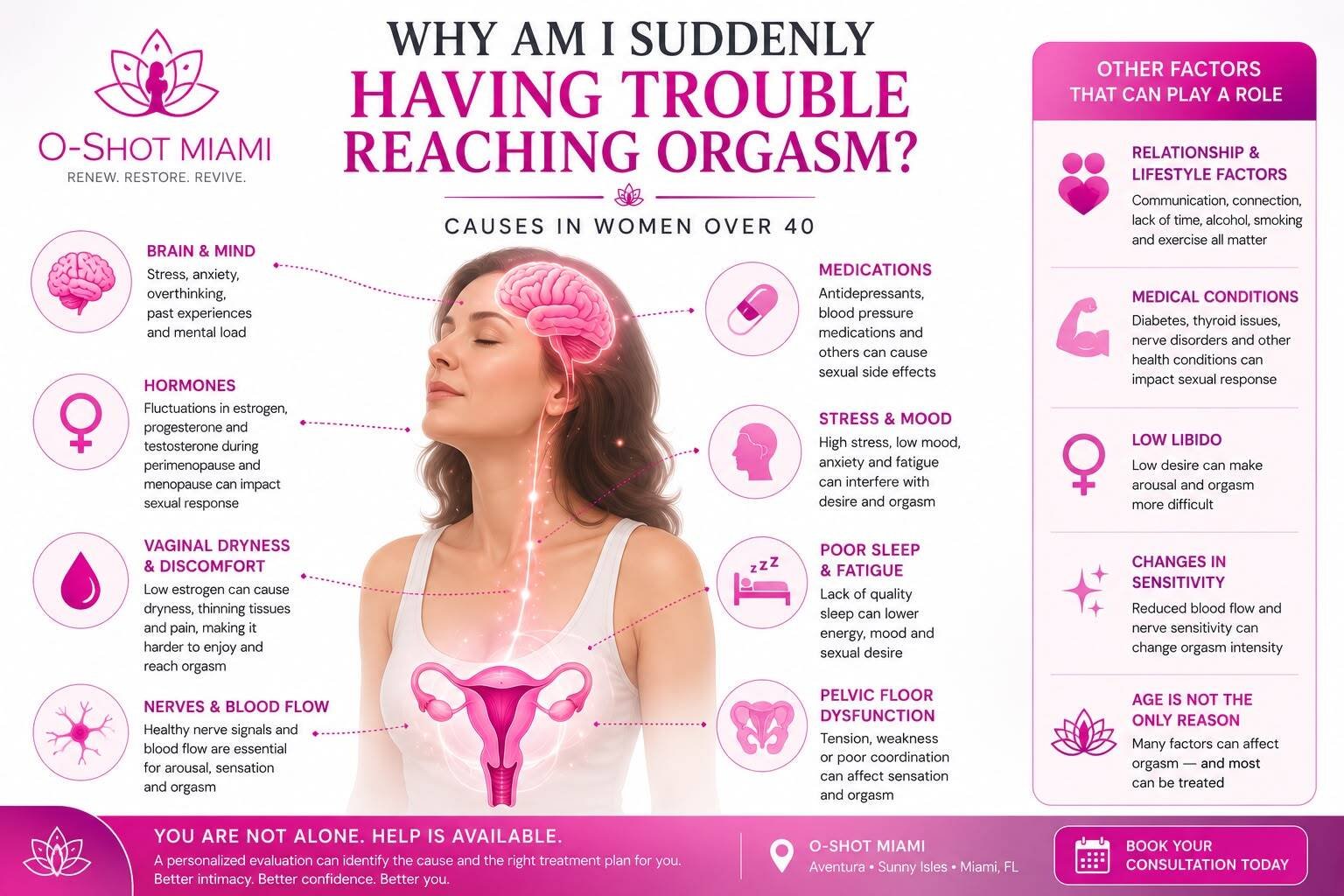
Quick Summary: Difficulty reaching orgasm after 40 is rarely caused by aging alone. Instead, it typically results from an intersection of perimenopausal hormonal fluctuations, vaginal dryness, medications (such as SSRIs), chronic stress, sleep disruption, pelvic floor muscle tension, or changes in sensory stimulation. Identifying these underlying contributors makes sudden anorgasmia manageable and treatable.
If reaching orgasm suddenly feels harder than it used to, you are not imagining the change. You can still feel deep romantic desire, enjoy physical affection, become aroused, and have a satisfying intimate life while noticing that climax takes much longer, feels muted, or sometimes does not happen at all.
That can feel disorienting—especially when your sexual response was predictable for decades. The first and most vital thing to understand is that difficulty reaching orgasm after 40 is not an inevitable sign that your sex life is over or that something is permanently broken. Sexual response is a finely tuned neurological, vascular, hormonal, and muscular process, and midlife brings changes to several of these systems simultaneously.
There is also no single "normal" orgasm. Some women reach climax quickly, while others need extended stimulation or specific angles of touch. Many women orgasm primarily through clitoral stimulation, others through combined stimulation, and response can vary widely from one encounter to another.
What matters clinically is a marked change from your own baseline. A woman who has always needed 25 minutes of direct stimulation is experiencing her normal biology, whereas someone who reliably reached climax within minutes and suddenly cannot is experiencing an acquired physiological shift.
Understanding Sexual Response After 40
There is no biological switch that flips on a woman’s 40th birthday to turn off her sexual vitality. Female sexual function evolves gradually through an interplay of biological, neurological, psychological, and relational influences.
During the 40s and 50s, the menopause transition (perimenopause) begins for most women. Ovarian production of estrogen, progesterone, and androgens becomes erratic, fluctuating unpredictably from month to month. At the exact same time, midlife frequently coincides with peak career demands, adolescent parenting, elder caregiving, relationship transitions, and cumulative physical stress.
An orgasm is the culmination of a complex biological team effort:
- The Brain & Neurotransmitters: Regulate dopamine, serotonin, and oxytocin to maintain focus and arousal.
- Microvascular Blood Flow: Engorges erectile clitoral tissues and produces vaginal transudate lubrication.
- Sensory Nerves: Transmit tactile pleasure signals through the pudendal nerve pathways.
- Pelvic Floor Muscles: Execute rhythmic involuntary contractions during orgasm.
- Hormones: Maintain mucosal thickness, elasticity, and local tissue receptivity.
If any one of these components experiences friction or disruption, climax can become delayed or elusive. That is why simply asking "Are my hormones low?" only scratches the surface of what is happening.
When a Change in Orgasm Deserves Medical Attention
Occasional difficulty reaching orgasm happens to every woman. Fatigue, an extra glass of wine, mental distraction, or rushing through intimacy can naturally alter an individual encounter.
However, a persistent or sudden change warrants a professional evaluation. In clinical medicine, difficulty or inability to experience climax despite adequate sexual excitement and stimulation is known as female orgasmic disorder or anorgasmia.
Clinicians classify this as acquired secondary anorgasmia when a woman with a history of reliable orgasms suddenly experiences difficulty. Distinguishing acquired difficulty from lifelong patterns ensures that underlying medical, hormonal, or neurological triggers are accurately identified.
9 Possible Causes of Sudden Orgasm Difficulty in Women Over 40
1. Perimenopause and Hormonal Fluctuations
Perimenopause can begin 4 to 8 years before menopause. Instead of dropping steadily, estrogen levels spike and plunge erratically. Estrogen plays a vital role in maintaining genital blood flow, mucosal thickness, and clitoral sensitivity.
When estrogen levels dip, the vulvar and vaginal tissues become thinner, drier, and less responsive. Even if you feel strong psychological desire, physical arousal may take substantially longer to manifest. Furthermore, hot flashes, night sweats, and mood volatility can drain your physical reserves.
Vaginal Dryness and Changes in Genital Tissue
Vaginal dryness affects over half of women during perimenopause. Decreased lubrication increases surface friction during penetration or tactile stimulation, causing micro-tears and stinging rather than pleasure. When your brain associates intimacy with friction, it automatically shifts attention toward monitoring discomfort, sabotaging the mental focus needed for orgasm.
2. Genitourinary Syndrome of Menopause (GSM)
Genitourinary Syndrome of Menopause (GSM) is the medical term encompassing tissue changes in the vulva, vagina, clitoris, and lower urinary tract caused by estrogen decline.
GSM causes burning, irritation, reduced transudate lubrication, vaginal atrophy, introital narrowing, urinary urgency, and recurrent UTIs. If genital stimulation produces irritation instead of pleasure, the body cannot build the neurological momentum required for orgasm.
3. Medications That Suppress the Orgasmic Reflex
One of the most frequent yet overlooked causes of sudden anorgasmia is a prescription medication change.
Selective Serotonin Reuptake Inhibitors (SSRIs) and Serotonin-Norepinephrine Reuptake Inhibitors (SNRIs)—widely prescribed for midlife depression, anxiety, and hot flashes—are notorious for blunting sexual response. By increasing serotonin, they can suppress dopamine and blunt the reflex arc that triggers orgasm.
Safety Tip: Never discontinue an antidepressant abruptly. If you noticed anorgasmia shortly after starting or changing a medication, consult your doctor about dose adjustments, timing shifts, or non-serotonergic alternatives (such as bupropion).
4. Chronic Stress and Mental Load
The brain is your most powerful sexual organ. Reaching orgasm requires down-regulating the sympathetic "fight-or-flight" nervous system and activating the parasympathetic "rest-and-digest" response.
When you carry heavy mental loads—juggling family, career, and personal health—cortisol and adrenaline remain elevated. During intimacy, intrusive thoughts ("Did I reply to that email?", "Why is this taking so long?") create performance anxiety, pulling mental focus away from physical sensation.
5. Fragmented Sleep and Exhaustion
Perimenopausal sleep disruption—caused by nighttime temperature spikes, anxiety, or insomnia—depletes daytime energy and blunts neurocognitive function. Physical intimacy requires cellular stamina and neurological concentration; when exhausted, sexual arousal often feels like an uphill chore rather than a pleasurable release.
6. Painful Sex (Dyspareunia)
Pain and orgasm are neurophysiologically incompatible. When penetration or touching causes burning, stinging, or deep pelvic ache, your body initiates a protective reflex:
Pain → Anticipation of Pain → Muscle Guarding → Decreased Lubrication → Blocked Orgasm
Whether pain stems from perimenopausal tissue thinning, infections, or postmenopausal estrogen loss, treating the pain is an essential first step to restoring orgasm.
7. Pelvic Floor Muscle Hypertonicity
The pelvic floor muscles undergo rhythmic contractions during orgasm. However, pelvic floor dysfunction does not always mean weakness. Many women over 40 develop hypertonic (chronically tight) pelvic floor muscles due to stress, previous childbirth trauma, or guarding against vaginal dryness.
Caution: Squeezing More Won't Help
If your pelvic floor is already overactive and clenched, performing extra Kegel exercises will exacerbate muscle fatigue and tightness. A specialized pelvic health physical therapist can assess whether you need down-training, myofascial release, and breath coordination to restore healthy contractions.
8. Diabetes, Microvascular Health, and Nerve Pathways
Clitoral erection and vaginal lubrication depend entirely on healthy microvascular blood supply and intact pudendal nerve signaling. Conditions like prediabetes, type 2 diabetes, atherosclerosis, hypertension, or past pelvic surgeries can impair nerve transmission and reduce vascular engorgement.
If your orgasm difficulty is accompanied by sudden genital numbness or sensory loss, prompt medical evaluation is necessary to assess vascular and neurological health.
9. Changes in Sexual Stimulation and Context
As hormone levels and anatomy evolve, what worked at 25 or 30 may no longer provide sufficient stimulation at 45 or 50. Most women require direct, continuous clitoral stimulation rather than vaginal penetration alone to climax.
If partnered intimacy has fallen into a predictable routine that rushes past foreplay, the body simply may not have enough time to achieve the vasocongestion necessary for climax.
Medical and Treatment Options: What Really Works?
What About Testosterone Therapy?
Testosterone is frequently promoted as a quick fix for midlife sexual wellness. While women naturally produce androgens that support libido and microvascular health, laboratory blood levels alone do not determine orgasmic ability.
Current clinical guidelines from the International Society for the Study of Women's Sexual Health (ISSWSH) endorse systemic testosterone therapy primarily for carefully screened postmenopausal women with Hypoactive Sexual Desire Disorder (HSDD), rather than as a standalone cure for orgasmic difficulty.
Can Hormone Optimization Help?
For women struggling with hot flashes, night sweats, sleep loss, and fatigue, comprehensive hormone optimization or Bioidentical Hormone Replacement Therapy (BHRT) can restore systemic hormonal balance. By improving sleep, mood, and pelvic blood flow, hormone therapy indirectly removes multiple barriers to sexual response.
Low-Dose Local Vaginal Estrogen
When GSM and vaginal dryness are the primary culprits, low-dose local vaginal estrogen (creams, tablets, or softgels) delivers targeted relief directly to mucosal tissues with minimal systemic absorption. By re-thickening the vaginal lining and restoring natural moisture, local estrogen eliminates the pain that prevents orgasm.
Regenerative Medicine: The O-Shot (PRP)
For women experiencing decreased sexual sensitivity and tissue thinning, the O-Shot procedure offers a regenerative approach.
The procedure isolates autologous platelet-rich plasma (PRP) from your own blood. When carefully injected into the clitoral and anterior vaginal tissues, concentrated growth factors stimulate local angiogenesis (new capillary formation), collagen regeneration, and nerve support. Many patients report enhanced natural lubrication, increased sensitivity, and stronger orgasmic response.
Read More on How the O-Shot Supports Female Orgasm →Why Can I Orgasm Alone but Not With My Partner?
This is an extremely common scenario and is actually good news: it proves your nerve pathways and orgasmic reflexes are completely intact.
During solo masturbation, you have 100% control over pressure, speed, rhythm, and mental focus without worrying about a partner's timing or expectations. Translating that success to partnered sex requires open communication, incorporating personal lubricants, extending arousal time, and removing the pressure to treat penetration as the required finale.
When Should You Consult a Women's Health Specialist?
You do not need to accept anorgasmia as your permanent reality. Schedule a confidential consultation if:
- Difficulty reaching orgasm is persistent and causing personal or relational distress.
- You experience new clitoral or genital numbness.
- Intercourse is accompanied by burning, tearing, or postcoital spotting.
- The change began immediately following a new prescription or dose increase.
- You are dealing with concurrent hot flashes, sleep fragmentation, or urinary urgency.
A dedicated evaluation with Dr. Nina Gupta in Aventura/Miami looks at the complete picture—hormones, microvasculature, medications, pelvic musculature, and lifestyle—to design a personalized roadmap back to intimate comfort.
The Bottom Line
Age alone does not turn off your ability to experience pleasure and climax. While perimenopause and midlife present genuine physiological challenges, difficulty reaching orgasm is a treatable symptom rather than an unchangeable fate. With accurate evaluation and evidence-based care, you can reclaim your intimate vitality and sexual confidence.
Frequently Asked Questions
Medical References & Clinical Guidelines
- American College of Obstetricians and Gynecologists (ACOG). Your Sexual Health & Vulvovaginal Health FAQs. acog.org
- The Menopause Society. The 2020 Genitourinary Syndrome of Menopause Position Statement. Menopause. 2020;27(9):976–992.
- Parish SJ, et al. International Society for the Study of Women's Sexual Health Clinical Practice Guideline for the Use of Systemic Testosterone for Hypoactive Sexual Desire Disorder in Women. Journal of Women's Health. 2021.
Medical Disclaimer: This article is for educational purposes only and does not replace individualized medical evaluation, diagnosis, or treatment. If you are experiencing sudden, severe, or persistent changes in sexual sensation or function, speak with a qualified healthcare professional.