
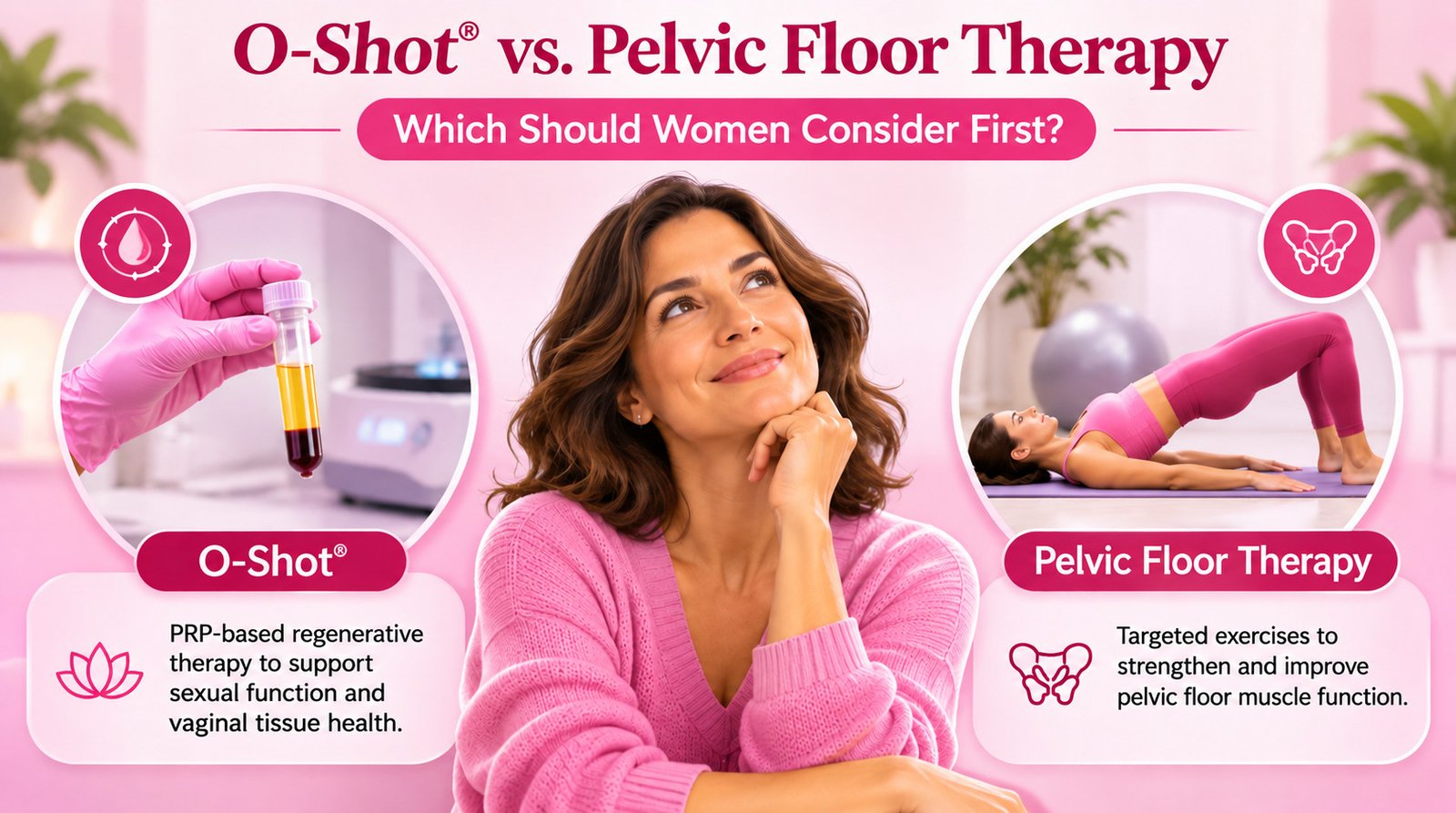
Clinical Overview: Treatment Sequence
Key Takeaway: For women experiencing stress urinary leakage or pelvic muscle tension, pelvic floor physical therapy is an established, non-invasive first-line standard of care. The O-Shot® uses autologous platelet-rich plasma (PRP) and remains an investigational, elective option. The most appropriate starting point depends entirely on an accurate medical diagnosis rather than treatment popularity.
Many women notice changes in their pelvic health as they get older. Some experience urinary leakage when laughing, coughing, or exercising. Others notice discomfort, changes in sensation, or difficulty enjoying intimacy.
These concerns are especially common after childbirth and during perimenopause or menopause. Unfortunately, many women hesitate to discuss them with their doctors. Some assume these changes are simply an inevitable part of aging.
The good news is that several treatment options are available. Two approaches that women frequently ask about are pelvic floor physical therapy and the O-Shot®, a procedure that uses platelet-rich plasma (PRP).
But which should you consider first? The answer depends on your symptoms, medical history, and the underlying cause of your concerns. Understanding how these treatments differ can help you make an informed decision.
What Is Pelvic Floor Therapy?
Pelvic floor physical therapy focuses on improving the function of the muscles that support the bladder, uterus, vagina, and rectum. These muscles play an important role in bladder control, bowel function, pelvic stability, and comfortable intimacy.
Like other muscles in the body, pelvic floor muscles can become weak, overly tense, or poorly coordinated. For example, pregnancy and childbirth may affect pelvic floor function. Menopause, chronic constipation, pelvic surgery, and certain medical conditions may also contribute to symptoms.
Pelvic floor physical therapy is designed to identify and address these problems. A trained pelvic health physical therapist evaluates how your pelvic floor muscles function and develops an individualized treatment program.
Treatment may include muscle-strengthening exercises, relaxation techniques, breathing exercises, biofeedback, and education about bladder habits.
Importantly, pelvic floor therapy is not simply about doing Kegel exercises. Some women need strengthening, while others need help relaxing muscles that are already too tight (hypertonic pelvic floor). That distinction matters because performing strengthening exercises incorrectly may worsen certain symptoms.
What Is the O-Shot®?
The O-Shot®, sometimes called the Orgasm Shot, is a procedure that uses platelet-rich plasma obtained from a patient’s own blood. PRP contains concentrated platelets and growth factors involved in normal tissue repair processes.
During the procedure, a small blood sample is collected and processed to separate platelet-rich plasma from other blood components. The PRP is then injected into selected tissues according to the physician’s treatment protocol.
The O-Shot® has been investigated for concerns involving female sexual function and urinary symptoms. However, the clinical evidence remains limited, and the procedure is not an established first-line treatment for urinary incontinence or female sexual dysfunction.
Although PRP is used in several areas of medicine, its effectiveness for these particular applications has not been established through large, high-quality clinical trials. The O-Shot® is not FDA-approved for treating urinary incontinence, low libido, or orgasm difficulties. Women considering this procedure should understand both the potential benefits being studied and the limitations of current research.
O-Shot® vs. Pelvic Floor Therapy: What Is the Difference?
Although both approaches may be discussed in connection with pelvic health, they work very differently. Pelvic floor therapy focuses on improving muscle strength, coordination, relaxation, and function. The O-Shot® involves injecting PRP into selected tissues, with the aim of investigating whether biological processes associated with tissue repair may influence symptoms.
Pelvic floor therapy has established clinical applications and is recommended in professional guidelines for several pelvic floor conditions. The O-Shot® remains an emerging intervention with insufficient evidence to establish consistent clinical effectiveness for these concerns.
| Feature | Pelvic Floor Therapy | O-Shot® PRP |
|---|---|---|
| Treatment approach | Physical rehabilitation | PRP injections |
| Main focus | Muscle function and coordination | Investigational tissue-based approach |
| Involves injections | No | Yes |
| Evidence for stress urinary leakage | Established treatment option | Limited evidence |
| Evidence for sexual concerns | Helpful for selected conditions (e.g. hypertonicity) | Preliminary research |
| Typical treatment plan | Multiple sessions and home exercises | Individualized procedure planning |
| FDA status | Established care approach | No FDA approval for these intended uses |
| Recovery | Usually minimal | Temporary discomfort, swelling, or bruising may occur |
The most appropriate option depends on the diagnosis rather than the treatment’s popularity.
Which Treatment Should You Consider for Urinary Leakage?
Urinary leakage is one of the most common reasons women seek pelvic health treatment. However, not all urinary leakage has the same cause.
Stress Urinary Incontinence (SUI)
Stress urinary incontinence occurs when urine leaks during activities that increase pressure inside the abdomen. Examples include:
- Coughing or sneezing
- Laughing
- Jumping
- Running
- Lifting heavy objects
This type of leakage often occurs when the muscles and tissues supporting the urethra cannot adequately maintain bladder control during physical activity.
Pelvic floor muscle training is an established first-line treatment for many women with stress urinary incontinence. A supervised program can help women learn how to activate and coordinate the correct muscles. The American Urological Association (AUA) and other professional organizations recognize pelvic floor muscle exercises as an important conservative treatment option.
What About the O-Shot® for Urinary Leakage?
Some preliminary studies have investigated PRP injections for stress urinary incontinence. However, the studies have generally been small, and treatment techniques and outcomes have varied. There is not enough reliable evidence to conclude that the O-Shot® provides consistent or long-lasting improvement in urinary leakage.
For most women with uncomplicated stress urinary incontinence, established conservative treatments should be considered before investigational PRP procedures. Explore our guide on when the O-Shot® is not the right first treatment.
Urgency and Overactive Bladder
Some women experience a sudden, difficult-to-control urge to urinate. Others need to use the bathroom frequently or wake up several times during the night. These symptoms may be associated with overactive bladder (OAB), but other conditions can produce similar symptoms.
Bladder training, behavioral changes, pelvic floor therapy, and selected medications may be recommended depending on the diagnosis. The O-Shot® has not been established as an effective treatment for overactive bladder. A proper medical evaluation is important before choosing any procedure.
Which Treatment Is Better for Painful Intimacy?
Pain during intimacy can have several causes. Common possibilities include vaginal dryness, hormonal changes, pelvic floor muscle tension, infections, inflammatory conditions, and certain skin disorders. Some women develop pain after childbirth, while others first notice symptoms during perimenopause or menopause. The correct treatment depends on identifying the cause.
When Pelvic Floor Therapy May Help
Women with overly tight or poorly coordinated pelvic floor muscles may benefit from specialized physical therapy. Treatment may include relaxation exercises, gentle manual techniques, breathing exercises, and strategies to reduce muscle guarding. For women whose discomfort is related to pelvic floor muscle dysfunction, therapy may improve comfort and function.
When Hormonal Changes Are Responsible
During menopause, declining estrogen levels can affect vaginal and urinary tissues. This may contribute to dryness, irritation, burning, and discomfort. These symptoms may be associated with genitourinary syndrome of menopause (GSM).
Evidence-based treatments include regular vaginal moisturizers, lubricants, and appropriate prescription therapies. For selected patients, low-dose vaginal estrogen or other approved therapies may be considered after reviewing individual medical history. Learn more in our menopause care guide.
The O-Shot® has not been established as a replacement for these treatments. Women experiencing persistent discomfort should receive an appropriate medical evaluation rather than assuming PRP is the best solution.
Can Pelvic Floor Therapy Improve Sexual Function?
Yes, pelvic floor therapy may help certain women whose sexual concerns are related to muscle dysfunction. Pelvic floor muscles contribute to pelvic support, comfort, and sexual response. Problems involving excessive muscle tension, weakness, or poor coordination may contribute to discomfort or difficulties during intimacy. A pelvic health physical therapist can help identify these issues.
However, sexual concerns are often multifactorial. Hormonal changes, medications, stress, sleep problems, relationship factors, and chronic medical conditions may also play a role. Pelvic floor therapy cannot address every possible cause. Read our guide on 12 causes of low libido in women.
Similarly, PRP injections should not be presented as a reliable treatment for low desire or orgasm difficulties. An individualized assessment is more useful than assuming one treatment can address every concern.
What Does Research Say About the O-Shot®?
Interest in PRP for female intimate wellness has increased in recent years. Researchers have investigated whether PRP injections may influence symptoms involving sexual function and urinary control. Some small studies have reported encouraging findings. However, several important limitations remain.
Many studies include relatively few participants. Some lack adequate placebo controls, while others use different injection techniques, PRP preparations, and outcome measurements. These differences make it difficult to compare results across clinics.
A small randomized study published in 2026 reported improvement in overall sexual-function scores among women receiving vaginal PRP compared with placebo. However, differences in individual sexual-function domains were not statistically significant. The findings are preliminary and do not establish that the O-Shot® reliably improves libido, lubrication, orgasm, or urinary symptoms. Read our detailed analysis on whether the O-Shot® really works.
Larger randomized trials with longer follow-up periods are needed. Women should also understand that an encouraging early study does not automatically establish a treatment as safe and effective for routine clinical use.
Can You Combine Pelvic Floor Therapy With the O-Shot®?
Some women ask whether pelvic floor therapy and PRP procedures can be used together. These approaches address different biological and functional processes.
However, there is currently insufficient evidence to establish that combining pelvic floor therapy with the O-Shot® produces better outcomes than established treatment alone. Pelvic floor therapy may be appropriate when muscle dysfunction is present.
If a patient is considering investigational PRP treatment, the physician should explain the uncertainties, potential risks, and available alternatives. Combining treatments should not replace a proper diagnosis or delay established care.
Who Should Consider Pelvic Floor Therapy First?
Pelvic floor therapy is often an appropriate early conservative treatment for women experiencing:
- Stress urinary leakage
- Pelvic floor muscle weakness
- Pelvic muscle tension or vaginismus
- Certain types of pelvic pain
- Discomfort associated with muscle dysfunction
- Postpartum pelvic floor symptoms
Note: Blood in the urine, recurrent UTIs, difficulty emptying the bladder, or unexplained pelvic pain require immediate medical evaluation.
Who Might Consider an O-Shot® Consultation?
Women interested in the O-Shot® may request a consultation to learn about PRP, its investigational applications, and evidence limitations:
- Review of current intimate symptoms
- Medical and medication history
- Previous treatments tried
- Menopausal and hormonal status
- Evaluation of pelvic floor dysfunction
- Established treatment alternatives
- Procedure-related risks & uncertainties
Learn more in our guide on who is a good candidate for the O-Shot®.
What Happens During a Pelvic Health Consultation?
At O-Shot® Miami, Dr. Nina Gupta, MD, ABAARM, FAARM, takes an individualized approach to women’s intimate wellness concerns. The first step is understanding what symptoms are affecting your quality of life.
For example, a woman experiencing urinary leakage after childbirth may have different treatment needs than someone experiencing vaginal dryness during menopause. Your consultation may include questions about bladder symptoms, childbirth history, hormonal changes, medications, previous procedures, and other relevant health concerns.
Depending on your symptoms, further examination, laboratory testing, or referral to a pelvic floor physical therapist or another specialist may be appropriate. The goal is to identify reasonable treatment options and explain their potential benefits and limitations. The right treatment begins with understanding the cause of your symptoms.
Compassionate, Physician-Led Pelvic Health Care
Schedule a private consultation with Dr. Nina Gupta, MD, to evaluate your pelvic symptoms and discuss evidence-based care.
Frequently Asked Questions
Is pelvic floor therapy better than the O-Shot®?
For women with pelvic floor dysfunction or uncomplicated stress urinary incontinence, pelvic floor therapy has stronger supporting evidence and is generally considered before investigational PRP injections. The best treatment depends on the underlying diagnosis.
Can the O-Shot® replace Kegel exercises?
No. The O-Shot® has not been shown to replace pelvic floor muscle training. Women with pelvic floor weakness may benefit from supervised rehabilitation.
Does pelvic floor therapy help after menopause?
Yes. Pelvic floor therapy may help selected menopausal women experiencing urinary leakage or pelvic muscle dysfunction. However, symptoms caused by estrogen-related tissue changes may require additional treatment.
Is the O-Shot® painful?
Patients may experience discomfort during PRP injections. Local anesthetic may be used, but temporary pain, swelling, bruising, or tenderness can still occur.
How many pelvic floor therapy sessions are needed?
The number of sessions varies according to symptoms, diagnosis, and progress. Many treatment programs involve several weeks or months of supervised therapy and home exercises.
How long do O-Shot® results last?
There is insufficient high-quality evidence to establish a reliable duration of benefit for the O-Shot®'s proposed intimate wellness applications. Individual experiences vary, and improvement cannot be guaranteed.
Is the O-Shot® FDA-approved?
No. The O-Shot® procedure is not FDA-approved for treating female sexual dysfunction, urinary incontinence, or menopausal symptoms. PRP preparation devices may have FDA clearances for specific purposes, but those clearances do not establish that the O-Shot® is safe or effective for these conditions.
Final Thoughts: Which Treatment Should Women Consider First?
Pelvic floor therapy and the O-Shot® are very different approaches. Pelvic floor therapy is an established treatment option for several conditions involving pelvic muscle function and urinary control. The O-Shot® is a PRP-based procedure being investigated for female intimate wellness concerns, but its effectiveness and long-term outcomes remain uncertain.
For many women experiencing urinary leakage or pelvic floor dysfunction, established conservative treatment is the appropriate starting point. Women experiencing vaginal dryness, painful intimacy, or changes in sexual function may need a broader evaluation that considers hormonal, muscular, psychological, and medical factors.
Rather than choosing a procedure based on advertising or online testimonials, consider discussing your symptoms with a qualified healthcare professional.
At O-Shot® Miami, Dr. Nina Gupta, MD, provides individualized consultations to help women understand their pelvic health concerns and available treatment options. Learn more about the O-Shot®, its evidence limitations, and consultation options at O-Shot® Miami or contact our Miami clinic.
Medical Disclaimer: This article is for educational purposes only and does not replace individualized medical advice, diagnosis, or care. PRP injections for female intimate wellness remain investigational. Results are not guaranteed, and established treatment alternatives should always be discussed with a qualified healthcare professional. Seek prompt medical care for unexplained vaginal bleeding, persistent pelvic pain, or acute urinary tract symptoms.